

Is there a real transaction behind your EPR credits?
Backtrace starts from the credits and works backwards to the waste the recycler must have bought, processed and sold. Then it checks every document along the way: invoices, e-way bills, weighbridge slips, toll records, power bills and sales.
Invoice SST/26-27/102 is missing from the recycler’s GSTR-2B, and its payment went to a different company. The other documents check out. Ask the recycler about it before you pay for the credits.
A certificate shows a number was uploaded. It doesn’t show the waste moved.
EPR credits are bought and sold on the strength of paperwork. When the paperwork is thin, these are the gaps people use.
Waste that was never bought
Invoices exist, but no e-way bill, weighbridge slip or toll record shows a truck carrying the scrap to the plant.
Documents used twice
One weighbridge slip, e-way bill or photo turns up behind credits issued to two different buyers.
A plant that couldn’t do it
The credits need more processing than the plant’s power bills and its consent to operate allow.
Five steps, about as long as it takes to collect the documents.
- Choose the wasteBattery, e-waste, plastic, tyre or used oil, and its type. Not sure? Pick “type not known”.
- Enter the creditsThe credits you hold or are about to buy, by metal or output.
- See the raw material neededThe least waste that could produce those credits, from its maximum metal or output content.
- Add the documentsUpload photos or PDFs. They are read for you; check the fields and correct anything misread.
- Get the verdictSupported, needs review or not supported, with the reason for every document.
Every stage has to hold up on its own.
A recycler can have perfect sale invoices and no trucks, or trucks and no power. So Backtrace checks each stage separately and asks a different question of each.
Did the material really arrive?
Follows the scrap from the seller’s invoice to the plant’s weighbridge.
- Purchase invoices and e-invoice QR codes
- E-way bills, including vehicle changes on the way
- Weighbridge slips at loading and unloading
- FASTag toll records on the route
- GSTR-2B and proof of payment to the seller
Could the plant really have processed it?
Caps what was received by what the plant could run.
- Electricity bills for the period
- SPCB consent to operate and its capacity
- Material received in Stage 1
Was the output really produced and sold?
Matches black mass or metal sold against the input that was proven.
- Sale invoices for black mass or metals
- Output backed by verified input
- HSN codes allowed for that waste type
The verified quantity is set by the weakest stage. If 20 t arrived but the power bills only support 12 t, Backtrace verifies 12 t.
Each document is checked for what it says and whether it’s real.
Every document comes back marked genuine, genuine with exceptions, rejected or unverifiable, with the reason.
The invoice reference number is recalculated from the GSTIN, year and invoice number. A made-up IRN doesn’t match.
The signature is checked against the portal’s published key, so an edited QR code fails.
An invoice the seller never filed doesn’t appear in GSTR-2B.
Against the invoice and slips, including Part B vehicle changes on the way.
Gross, tare and net are checked, and a slip number used in an earlier check is flagged.
Toll crossings must fit between loading and arrival on the route.
A payment to anyone other than the invoiced seller is flagged.
Units consumed and the consent’s permitted capacity cap what could be processed.
Taken in the app; the time comes from Circle8’s server, and the same photo can’t be used twice.
What you’ll see.
Real screens from Backtrace, with made-up demo companies.
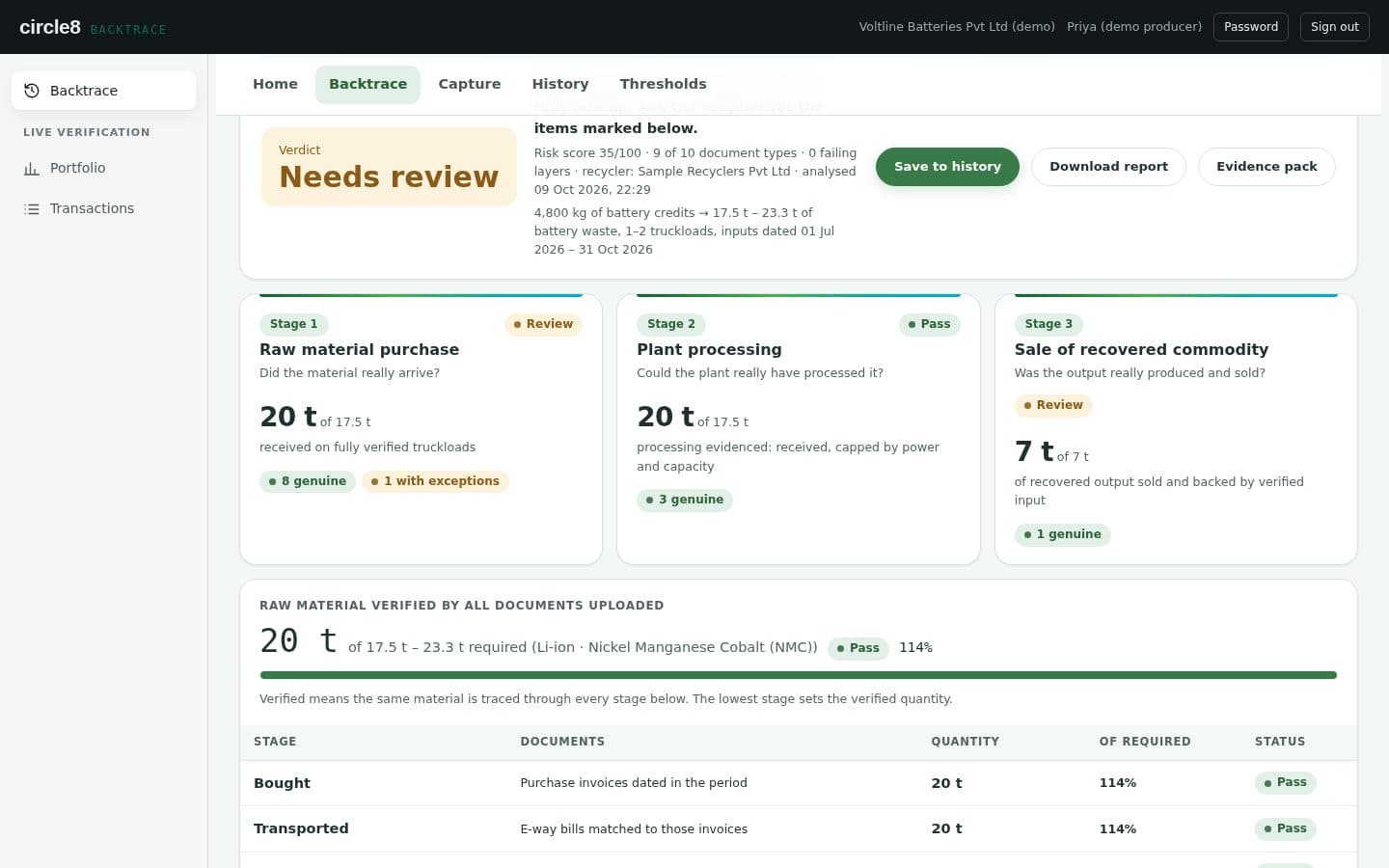
A verdict with its reasons
The sample pack after checking: “Needs review”, a risk score, the three stages and the raw material verified against what the credits need. Save it, download the report or the evidence pack.
Everyone on the paper trail, each with their own view.
Check credits before you buy them
Brand owners and importers buying battery, e-waste, plastic, tyre or used-oil credits.
- Backtrace any certificate or offer
- Keep every check, with the evidence pack
- Share a check with your auditor
Prove your credits are real
Plants that issue credits and want buyers to trust them.
- Capture trucks at loading and unloading
- Run the same checks your buyers will
- Fix gaps before a buyer finds them
See the evidence, read-only
Auditors and regulators a company chooses to share with.
- Open shared checks and their documents
- Download the report and evidence pack
- Nothing else is visible, and nothing can be changed
Each type has its own content limits and allowed HSN codes. “Type not known” is available for every waste.
Start free. Upgrade when checks become routine.
Free
₹0- New checks a month5
- Documents read automatically25 a month
- Truck photo captureYes
- Saved history and evidence packYes
- Share with auditors and CPCBNo
- Live government lookupsNo
Paid
Talk to us per company- New checks a monthNo limit
- Documents read automatically2,000 a month
- Truck photo captureYes
- Saved history and evidence packYes
- Share with auditors and CPCBYes
- Live lookups: GST, e-invoice, e-way bill, FASTag, VAHANcomingYes
Monthly counts reset on the 1st (India time). Opening or updating a saved check never counts.
Built for documents that end up in front of a regulator.
Stored on Circle8’s servers and visible only to your company, and to Circle8 for support.
Documents are read on the server. No reading keys are ever sent to your browser.
Only your company’s admins can share a check, one check at a time, and can take it back.
Read-only. They see shared checks and nothing else.
Time-stamped by the server, fingerprinted, and refused if reused.
Sign-ins, changes, shares and downloads are logged.
Common questions.
Does Backtrace replace the CPCB portal?
No. Credits are still issued and transferred on the CPCB EPR portal. Backtrace checks whether the transaction behind a credit holds up, before you buy it or when you’re asked to prove it.
What do I need to run a check?
The credit details and the recycler’s documents for the period: purchase invoices, e-way bills, weighbridge slips, toll statement, GSTR-2B, payment proof, power bills, consent to operate and sale invoices. Missing documents don’t stop the check; they show up as gaps in the verdict.
How are documents read?
Upload photos or PDFs and Backtrace reads the fields for you. Always check what was read and correct anything wrong; the verdict uses the fields as you confirm them. You can also type details in.
Can the recycler see my check?
No. A check is visible to your company only, unless your admin shares it with an auditor or CPCB.
Which waste types are covered?
Battery, e-waste, plastic packaging, tyres and used oil. Each has its own content limits and allowed HSN codes, which Circle8 maintains.
Is a “Supported” verdict a guarantee?
No. It means the documents you provided back the credits at every stage. It reduces the risk of buying fake credits; it doesn’t replace your own due diligence or legal advice.
Who runs Backtrace?
Circle8 Cleantech Private Limited, which trades scrap lithium-ion batteries and EPR credits. We built Backtrace to check the credits we deal in.
Backtrace your next credit before you pay for it.
Five free checks a month. No card needed. Producers and recyclers can sign up in a minute.
Sign-up opens when Backtrace launches.